A relationship rarely breaks in a single day.
Thank you for reading this post, don't forget to subscribe!More often, the distance builds quietly. A few unresolved arguments turn into resentment. Conversations become shorter. One partner stops sharing what they are feeling. Trust gets damaged. Affection starts disappearing. Eventually, two people who once felt deeply connected may find themselves living alongside each other without really feeling close.
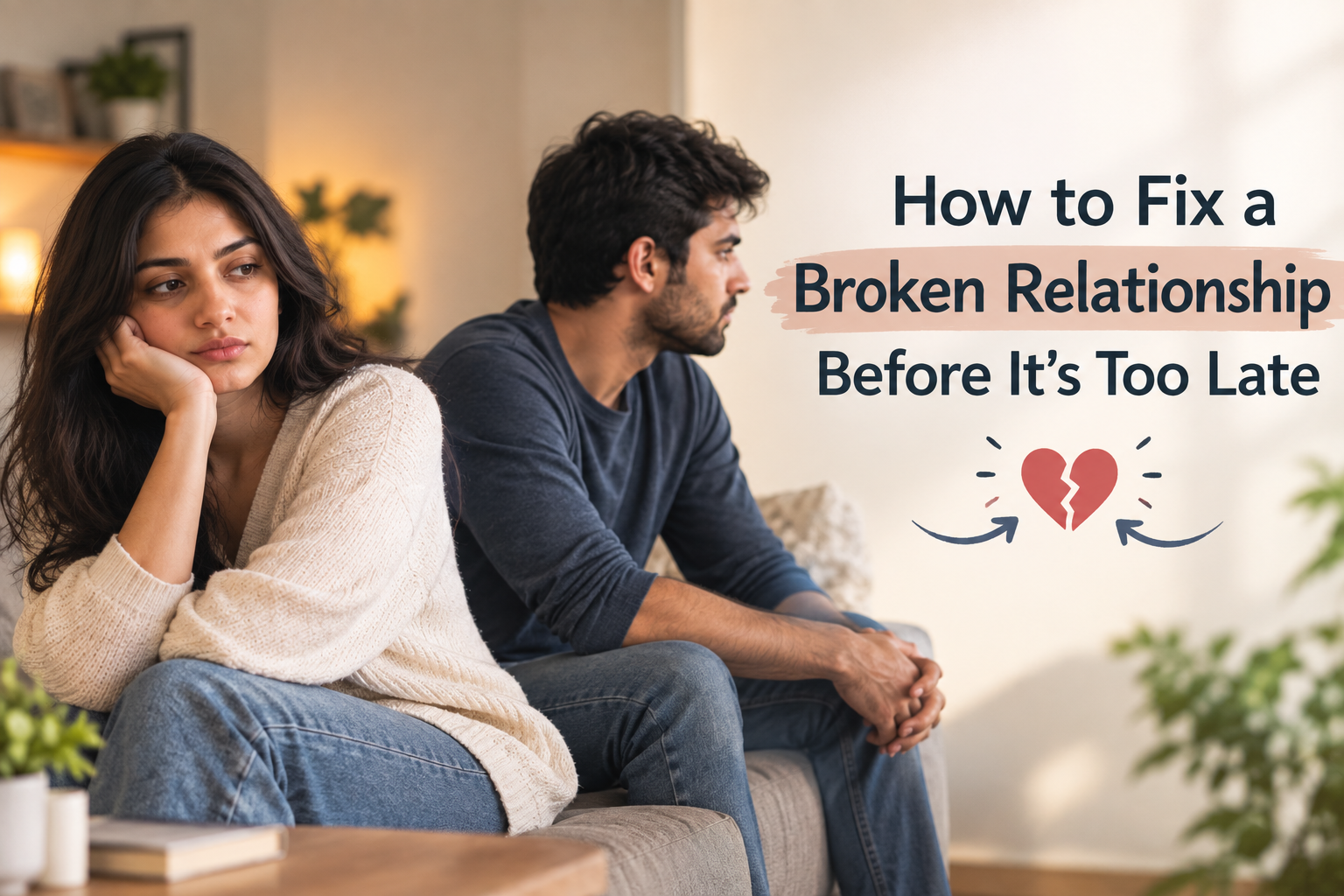
By the time someone searches for how to fix a broken relationship before it’s too late, they may already be exhausted. They may wonder whether the relationship can actually be repaired or whether they have simply waited too long.
But “broken” does not always mean “over.”
Relationships can go through painful phases and still have room for repair. What matters is what both people are willing to do next. If there is still some care, respect, emotional safety, and willingness to understand what went wrong, rebuilding may be possible.
The mistake is assuming that things will eventually get better on their own. Usually, unresolved hurt does not disappear. It settles into the relationship and changes the way two people respond to each other.
Repair begins when someone is willing to stop ignoring the distance and start understanding it.
Is a Broken Relationship Always Beyond Repair?
Not necessarily.
A relationship can be deeply strained without being permanently damaged. Couples can go through periods of anger, emotional distance, repeated disagreements, or even a serious breach of trust and still find a way forward.
The more useful question is not simply, “How bad has it become?”
Ask instead, “Is there still a willingness to repair it?”
Some signs that a relationship may still have room for repair include:
- Both partners still care about what happens to the relationship.
- There is some willingness to have honest conversations.
- Both people can acknowledge that they may have contributed to the problems.
- Basic respect is still present.
- Both partners are willing to make meaningful behavioural changes.
- There is enough emotional safety to have difficult conversations.
Love matters, but love by itself cannot carry a relationship through everything. If there is no accountability, respect, trust, or willingness to change, strong feelings may not be enough to create a healthy relationship.
Repair requires participation, not just hope.
Signs Your Relationship May Be Breaking Down

Sometimes the warning signs are obvious. Other times, they are so gradual that couples only recognize them once the emotional distance has become significant.
You Stop Talking About Real Things
You still talk, but most conversations are about groceries, work, children, bills, chores, or schedules.
The things you actually feel remain unspoken.
Over time, practical communication can replace emotional communication. You know what your partner needs from the supermarket, but you no longer know what has been worrying them.
Every Conversation Turns Into an Argument
Even small topics become emotionally charged.
A simple question can sound like criticism. A disagreement about plans suddenly becomes an argument about the entire relationship. Both people become defensive before the conversation has even properly started.
When this happens repeatedly, couples may begin avoiding conversations altogether.
Emotional Withdrawal Has Replaced Connection
One or both partners stop sharing their thoughts, worries, excitement, or vulnerability.
You may spend the entire evening together and still feel completely alone.
Emotional withdrawal can sometimes look like indifference, but underneath it may be hurt, exhaustion, fear of another argument, or the belief that talking will not change anything.
Resentment Keeps Building
Small disappointments become evidence for a much bigger story.
One person may feel, “I’m always the one making an effort.” The other may feel, “Nothing I do is ever enough.”
When resentment grows, even neutral actions can be interpreted negatively.
Trust Has Been Damaged
Lying, secrecy, repeated broken promises, emotional betrayal, or infidelity can change the sense of safety within a relationship.
Once trust is damaged, the problem is not always the original incident. It is also the uncertainty that follows: Can I believe you now? Will this happen again?
Intimacy Has Disappeared
Emotional and physical intimacy can both decline when a relationship is under strain.
There may be less affection, fewer meaningful conversations, less desire for physical closeness, or a growing tendency to avoid intimacy altogether.
Sometimes the lack of intimacy is a symptom of a deeper problem rather than the original cause.
You Feel More Like Roommates Than Partners
Life becomes a list of responsibilities.
Who is picking up the children? Who is paying the bill? What needs to be bought? What needs to be done tomorrow?
You may still function well as a household, but the sense of being a couple has started to disappear.
One sign alone does not necessarily mean your relationship is ending. The concern is when these patterns become persistent and neither person knows how to change them.
Before You Try to Fix the Relationship, Understand What Actually Broke
This is where many couples get stuck.
They focus on the latest argument because it is the easiest problem to see. Maybe the argument was about money, sex, household responsibilities, a forgotten anniversary, or spending too much time on the phone.
But the argument itself may not be the real problem.
A disagreement about household chores may actually be about feeling unsupported. An argument about intimacy may be about rejection or emotional disconnection. Repeated fights about money may be connected to deeper concerns about security, control, or responsibility.
Before trying to fix a relationship, ask:
- When did we start feeling distant?
- What keeps causing the same arguments?
- What does each of us feel we are missing?
- Is there unresolved hurt from the past?
- Has trust been damaged?
- Has stress changed how we treat each other?
- Have our needs or expectations changed over time?
Sometimes the most important conversation is not, “Why did we fight yesterday?”
It is, “What has been happening between us for the past few months?”
You cannot repair a problem you have not understood.
Have an Honest Conversation Without Trying to Win

If you want to fix a relationship that is falling apart, eventually there has to be an honest conversation.
That does not mean sitting down and listing everything your partner has done wrong.
Choose a relatively calm time. Talk about the relationship as a whole rather than focusing only on the most recent incident. Give both people enough room to speak.
Try to describe your experience instead of attacking your partner’s character.
Instead of:
“You don’t care about me anymore.”
Try:
“I’ve been feeling emotionally distant from you, and I want us to understand what has changed.”
The second statement may still lead to a difficult conversation, but it creates space for one.
Ask your partner what they have been feeling. What do they miss? What do they need? What has been difficult for them?
And when they answer, resist the urge to immediately defend yourself.
You may hear something uncomfortable. Listening does not mean agreeing with every accusation or accepting unfair blame. It means being willing to understand before deciding how to respond.
Sometimes that willingness is the first sign that repair is possible.
Stop Repeating the Same Conflict Pattern
Many couples are not actually having the same argument over and over. They are repeating the same pattern.
It may look something like this:
Trigger → Argument → Defensiveness → Withdrawal → Unresolved hurt → Same argument again
One partner wants to talk immediately. The other needs space and shuts down. The more one pushes for an answer, the more the other withdraws. The withdrawal then makes the first person more anxious, so they push harder.
Eventually, both people feel misunderstood.
Recognizing this cycle can be more useful than deciding who is “the problem.”
Take a Healthy Pause
When an argument becomes too intense, taking some space can prevent things from getting worse.
But there is a difference between taking a healthy pause and using silence as punishment.
A healthy pause sounds like:
“I’m too upset to have this conversation properly right now. I need some time to calm down, but I want to come back to this tonight.”
The important part is returning to the conversation.
Walking away indefinitely, refusing to speak, or deliberately making your partner anxious is not the same thing as taking space.
Rebuild Emotional Connection Before Expecting Everything Else to Improve
When a relationship is struggling, couples often focus immediately on solving practical problems.
They make rules. They discuss responsibilities. They try to stop arguing.
Those things can help, but emotional connection also needs attention.
Start small.
Ask your partner how their day actually felt, not just how it went. Remember something they told you earlier. Sit together without your phones. Share a meal. Take a walk. Laugh about something. Show up when they are having a difficult day.
You do not have to recreate the beginning of your relationship overnight.
In fact, repair often starts with something much quieter: making the relationship feel emotionally safe again.
Dr. Neha’s approach to relationship concerns emphasizes understanding the emotional experience underneath the visible problem. Sometimes couples become so focused on who is right that they stop asking what each person is actually feeling.
Connection can begin to return when both people feel that their inner world matters.
How to Rebuild Trust After It Has Been Broken
Trust is easier to damage than to rebuild.
One apology may be necessary, but it is rarely enough by itself.
The person who caused the hurt needs to take responsibility without minimizing what happened or shifting the blame back to their partner. At the same time, the person who was hurt may need time to process what happened and decide what they need in order to feel safe again.
Do not demand immediate forgiveness.
Rebuilding trust usually involves:
- Honest communication
- Consistent behaviour
- Following through on promises
- Taking responsibility for mistakes
- Being willing to answer reasonable questions
- Creating clear boundaries
- Avoiding the behaviour that caused the damage
Trust comes back through repeated experiences. Your partner needs to see that the change is not simply a reaction to the current crisis.
That can take time, and there is no healthy shortcut around it.
Don’t Ignore Intimacy and Physical Connection
Relationship problems often affect physical intimacy.
When someone feels rejected, angry, emotionally disconnected, or unsafe, sexual desire may naturally change. This is why a sudden decline in intimacy is not always the original problem. Sometimes it is a reflection of what is happening emotionally.
At the same time, physical intimacy should not be ignored or treated as unimportant.
Talk about affection, desire, comfort, boundaries, and unmet needs without turning the conversation into criticism.
If sex has become difficult, it may help to rebuild non-sexual affection first holding hands, hugging, sitting close, kissing, or simply feeling comfortable around each other again.
Do not use sex as a test:
“If we have sex again, does that mean we’re fixed?”
It does not.
Intimacy should be mutual, wanted, and free from pressure. A healthier physical connection usually grows from emotional safety rather than being forced into existence to cover unresolved problems.
Make Changes You Can Actually Maintain

When people are afraid of losing a relationship, they sometimes make huge promises.
“I’ll never get angry again.”
“I’ll change everything.”
“We’ll never fight like this again.”
The intention may be sincere, but these promises are difficult to maintain.
Instead, agree on specific behaviours.
For example:
- Have one uninterrupted conversation each day.
- Set aside regular quality time together.
- Do not use insults during disagreements.
- Discuss major decisions rather than making them alone.
- Express appreciation regularly.
- Follow through on agreed responsibilities.
- Return to difficult conversations instead of avoiding them indefinitely.
A small change that happens consistently is usually more meaningful than a dramatic promise that disappears after a week.
What Not to Do When Trying to Save a Broken Relationship
Fear can make people behave in ways that create even more distance.
If you are trying to repair a relationship, avoid:
- Begging your partner to stay.
- Threatening separation every time you argue.
- Using guilt to get affection or attention.
- Bringing every past mistake into a current disagreement.
- Checking phones or invading privacy as a replacement for rebuilding trust.
- Using the silent treatment as punishment.
- Trying to make your partner jealous.
- Pressuring them into physical intimacy.
- Taking all the blame simply to prevent the relationship from ending.
- Expecting one person to carry all the emotional work.
Repair is about changing unhealthy patterns, not finding better ways to control the other person.
You cannot manipulate someone into feeling close to you again.
What If Only One Person Wants to Fix the Relationship?
This can be one of the hardest realities to accept.
One person can change their own behaviour. You can communicate more clearly, stop participating in destructive arguments, apologize for your mistakes, set healthier boundaries, and invite your partner into a more constructive conversation.
But you cannot repair a two-person relationship entirely on your own.
You cannot force someone to trust you, communicate with you, stay with you, or change their behaviour.
If your partner is willing to participate, even small changes can become the beginning of something better. If they are not, there may come a point when the question changes from:
“How do I save this relationship?”
to:
“What do I need to protect my own emotional wellbeing?”
Accepting that difference can be painful, but it is also important.
When Couples Counseling Can Help
You do not have to wait until the relationship is almost over before seeking professional support.
Couples counseling may help when:
- The same conflict keeps repeating.
- Communication has broken down.
- Trust has been damaged.
- Emotional or physical intimacy has changed significantly.
- Resentment has been building for months or years.
- One or both partners feel consistently unheard.
- Difficult conversations quickly turn into arguments.
- You want help understanding recurring relationship patterns.
A relationship professional can provide a neutral environment where both partners have an opportunity to slow down, identify unhealthy cycles, and understand what is happening beneath the surface.
Seeking help early can sometimes be easier than trying to repair years of accumulated resentment.
When a Relationship Should Not Be “Fixed” at Any Cost
A difficult relationship and an unsafe relationship are not the same thing.
Arguments, misunderstandings, and periods of emotional distance can sometimes be worked through. Abuse should never be treated as an ordinary communication problem.
If a relationship involves physical violence, sexual coercion, threats, intimidation, coercive control, or severe emotional abuse, the priority is safety.
Someone experiencing abuse does not need to communicate more perfectly, become more patient, or try harder to make the relationship work.
Appropriate individual support and safety planning may be more important than couples counseling in these circumstances.
A relationship is not healthy simply because it stays together. Safety, dignity, consent, and freedom from fear matter too.
How Long Does It Take to Fix a Broken Relationship?
There is no universal timeline.
A couple dealing with a recent communication problem may notice improvement relatively quickly. Rebuilding trust after betrayal or years of resentment can take considerably longer.
The timeline depends on what happened, how long the problem has existed, whether both people are willing to change, and how deeply trust or emotional safety has been affected.
You may notice small improvements early, but deeper repair usually comes from consistency over time.
Try not to measure progress by asking, “Are we completely okay now?”
A better question may be:
“Are we handling things a little differently than we were before?”
If the answer gradually becomes yes, that matters.
Conclusion
A relationship usually does not fall apart overnight, and it often cannot be repaired overnight either.
If both partners still have some willingness, respect, and emotional safety, there may be a path back. Start by looking beneath the arguments. Understand what each person has been missing, talk honestly without trying to win, interrupt destructive conflict patterns, and rebuild trust through actions that are consistent enough to be believed.
Do not wait for a dramatic crisis before taking the relationship seriously. Sometimes the most meaningful repair begins with something very ordinary one honest conversation, one sincere apology, one evening without distractions, or one decision to listen instead of becoming defensive.
And remember that asking for help does not mean your relationship has failed. From Dr. Neha’s perspective, reaching out for support can simply mean that the relationship matters enough to understand more deeply and work on with care.
The goal is not to recreate the relationship exactly as it was. It is to build a healthier way of being together with more honesty, understanding, emotional safety, and mutual effort.
FAQs
1. Can a broken relationship really be fixed?
Yes, some relationships can recover from serious difficulties when both partners are willing to communicate honestly, take responsibility, rebuild trust, and make consistent changes. However, love alone is not enough if there is no mutual effort, respect, or emotional safety.
2. How do I fix a relationship that is falling apart?
Start by understanding what has actually gone wrong rather than focusing only on the latest argument. Then work on communication, break destructive conflict patterns, rebuild trust through consistent actions, reconnect emotionally, and consider professional support if you remain stuck.
3. Can you fix a relationship if your partner is emotionally distant?
You can invite connection, create a safer environment for conversation, and change how you respond to your partner. But you cannot force emotional closeness; your partner also needs to be willing to participate.
4. How do you rebuild trust in a relationship?
Trust is rebuilt through accountability, honesty, consistency, and time. The person who caused the hurt needs to demonstrate meaningful change rather than relying on apologies alone, while both partners may need to establish clearer boundaries.
5. Can communication save a broken relationship?
Healthy communication is essential, but communication alone cannot solve every relationship problem. Trust, accountability, respect, compatibility, and actual behavioural changes also need attention.
6. What if my partner doesn’t want to fix the relationship?
You can control your own behaviour, communicate your willingness to work on things, and invite your partner into a constructive conversation. You cannot force them to stay, change, trust, or participate, so eventually you may need to consider what is healthiest for you.
7. Should we try couples counseling?
Couples counseling can be useful when recurring conflict, communication problems, trust issues, intimacy changes, or resentment are difficult to resolve independently. However, when there is abuse, coercion, or fear for safety, individual safety and specialist support should take priority.
8. Can a relationship recover after betrayal?
Some couples do recover after betrayal, but the process can be difficult and different for every couple. Accountability, honesty, transparency, willingness to change, and enough time to rebuild trust all matter.