
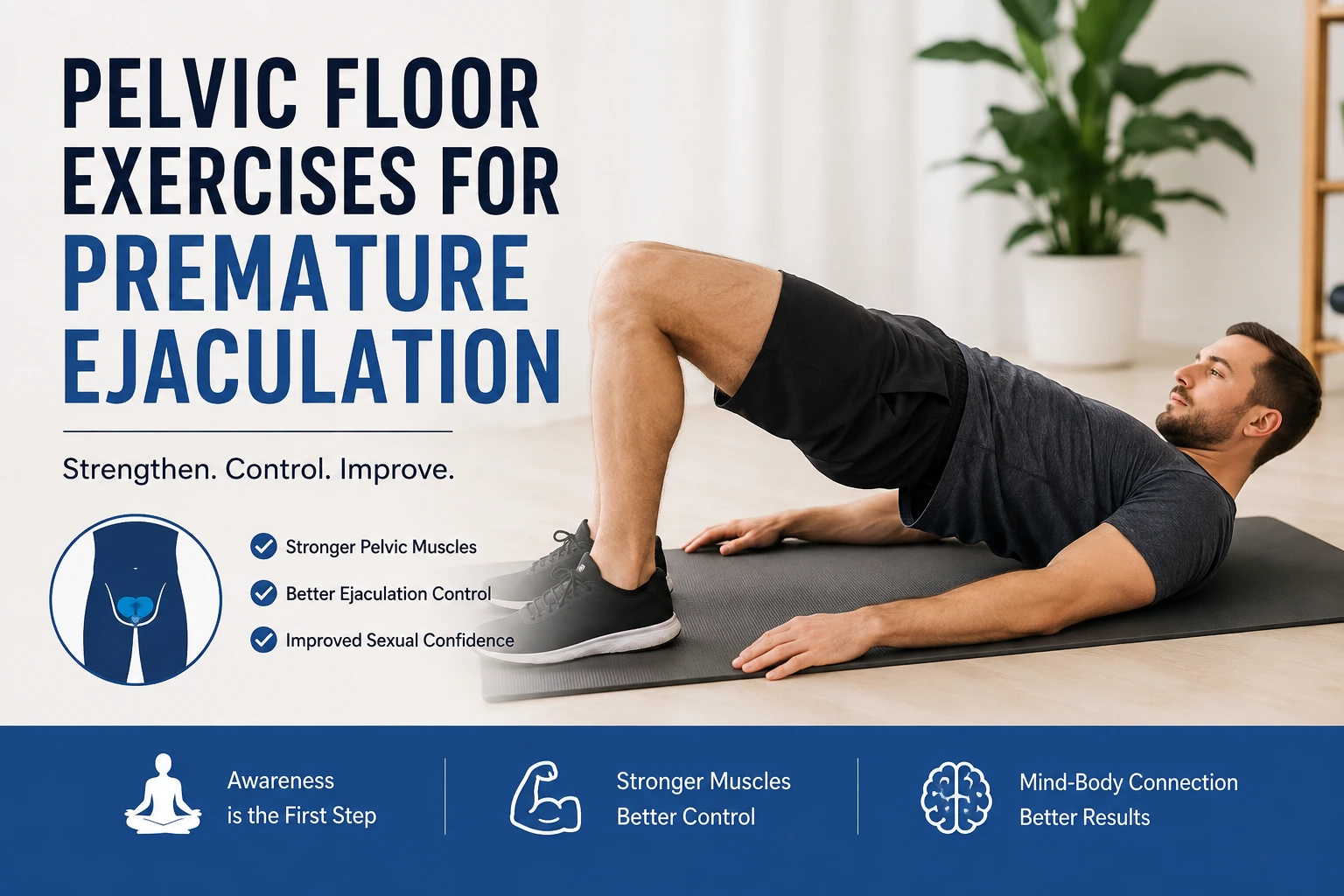
Premature ejaculation (PE) can be frustrating, especially when you feel like your body is moving faster than you want it to. You may find yourself reaching orgasm sooner than expected, having difficulty slowing things down, or worrying about it happening again the next time you have sex. Over time, that worry itself can make sexual experiences more stressful.
Thank you for reading this post, don't forget to subscribe!One area that is often overlooked when talking about ejaculation control is the pelvic floor. These are a group of muscles at the bottom of the pelvis that play a role in urination, erections and ejaculation. Learning how to contract and relax them properly may help some men develop better awareness and control during sexual activity.
This is where pelvic floor exercises for premature ejaculation can be useful, although some men may also benefit from premature ejaculation treatment.
Kegel exercises and other forms of pelvic floor muscle training have shown promise in research, although they are not a guaranteed cure and should not be treated as the only solution. Recent research suggests pelvic floor training may improve ejaculation control in some men, while results vary depending on the individual and the type of training used.
What Are Pelvic Floor Muscles?
Think of the pelvic floor as a supportive layer of muscles at the bottom of your pelvis. These muscles help support the bladder and bowel and are involved in several functions related to sexual health.
In men, the pelvic floor muscles contribute to:
- Controlling urine flow
- Supporting erections
- Moving semen during ejaculation
- Contributing to the rhythmic contractions associated with orgasm
- Maintaining control over pelvic muscle activity
During sexual stimulation, the pelvic floor naturally becomes more active. If you learn to recognize these muscles and control their contraction and relaxation, you may become more aware of what is happening as arousal increases.
That awareness matters. Ejaculation control is not just about having stronger muscles. It is also about timing, relaxation and recognizing the point at which arousal is becoming difficult to control.
Can Pelvic Floor Exercises Help With Premature Ejaculation?
There is evidence that pelvic floor muscle training can help some men with premature ejaculation.
Earlier clinical studies found improvements in ejaculation control following structured pelvic floor rehabilitation. More recent research has also reported improvements in ejaculation time and PE symptoms following pelvic floor muscle training.
However, the evidence is not strong enough to say that Kegels work equally well for everyone. A 2026 systematic review and meta-analysis of randomized controlled trials found that pelvic floor muscle training may help, but its effects were smaller than some established treatments, and the studies used different exercise protocols.
So, it is better to think of these as exercises for ejaculation control, rather than a quick fix.
Pelvic floor training may help you:
- Become more aware of pelvic muscle tension
- Improve voluntary control over pelvic contractions
- Recognize changes in arousal earlier
- Coordinate contraction and relaxation more effectively
- Build confidence around sexual control
For some men, combining pelvic floor training with breathing exercises and behavioural techniques may be more useful than doing Kegels alone. One recent randomized trial found that adding diaphragmatic breathing to behavioural therapy and pelvic floor training produced better outcomes than behavioural therapy and pelvic floor training alone.
How to Find Your Pelvic Floor Muscles
Before starting Kegel exercises for men, you need to know which muscles you are actually trying to train.
One simple way to identify them is to briefly try to stop your urine flow while urinating. The muscles you use for that action are part of your pelvic floor.
But there is an important distinction: do not regularly practice Kegels while urinating.
Stopping your urine stream can help you identify the muscles once or twice, but repeatedly interrupting urination as an exercise may interfere with normal bladder emptying.
Once you have identified the muscles, practice when your bladder is empty.
You are probably using the right muscles if you feel a gentle lifting or tightening sensation around the pelvic area without strongly squeezing your stomach, thighs or buttocks.
Keep your breathing normal. Your face, legs and abdomen should remain relaxed.
5 Pelvic Floor Exercises for Premature Ejaculation
1. Basic Kegel Exercises
Basic Kegels are the easiest place to start.
Sit or lie down comfortably and relax your body. Gently contract your pelvic floor muscles as though you are trying to prevent passing gas or briefly stop urine flow.
Hold the contraction for about 3–5 seconds, then completely release it for the same amount of time.
Start with:
- 10 repetitions
- One set at a time
- Once or twice a day
As the exercise becomes easier, you can gradually work toward longer holds. There is no need to squeeze as hard as possible. A controlled contraction is more useful than an aggressive one.
2. Slow Pelvic Floor Contractions
Slow contractions focus more on control and endurance.
Contract your pelvic floor gently and hold for around 5–10 seconds, depending on your current ability. Then release slowly and allow the muscles to relax completely before repeating.
The relaxation phase is important.
Many people focus so much on squeezing that they forget the second half of the exercise. But if your pelvic floor remains tense throughout the day, repeatedly tightening it may not be helpful.
Think of each repetition as:
Contract → hold → release → relax.
Over time, this can help you become more comfortable controlling the muscles without keeping them permanently tense.
3. Quick Pelvic Floor Contractions
Quick contractions are different from slow Kegels.
Instead of holding the muscle, contract it briefly and release it immediately.
For example:
Squeeze → release → squeeze → release.
Try 10 quick contractions initially, followed by a period of relaxation.
These short contractions can help you practice responding to changes in pelvic muscle activity. They are not meant to be performed as forcefully or as rapidly as possible.
Quality matters more than speed.
4. Pelvic Floor Relaxation
This exercise may sound strange in an article about strengthening the pelvic floor, but it is one of the most important parts of training.
A pelvic floor that is constantly clenched is not necessarily a well-controlled pelvic floor.
Sit comfortably and take a slow, deep breath into your abdomen. As you inhale, consciously allow your pelvic area to soften. As you exhale, let your body remain relaxed.
Do not push or strain. The goal is simply to notice the difference between tension and relaxation.
This can be especially useful if you notice that you tighten your pelvic muscles, abdomen or buttocks when you become sexually excited, particularly if sexual performance anxiety also makes it difficult to stay relaxed.
5. Pelvic Floor Exercises With Breathing
Once you are comfortable with basic contractions, combine them with slow breathing.
Take a relaxed breath in. As you exhale, gently contract your pelvic floor. Hold the contraction briefly without holding your breath. Then release and take another slow breath.
You can also practice the opposite: inhale and consciously relax your pelvic floor.
This helps connect breathing, arousal and pelvic muscle awareness rather than treating the muscles as something you simply squeeze repeatedly.
Breathing-based approaches are becoming increasingly relevant in PE management. Research has found benefits when diaphragmatic breathing is combined with pelvic floor and behavioural training.
How Often Should You Do Pelvic Floor Exercises?
You do not need to spend a long time exercising your pelvic floor every day.
If you are a beginner, start with around 10 controlled contractions once or twice a day. As your muscles become more comfortable with the exercises, gradually increase the duration or number of repetitions.
The goal is consistency, not exhaustion.
Doing hundreds of Kegels every day will not automatically improve ejaculation control faster. Like any other muscle group, the pelvic floor needs periods of relaxation.
If you develop pelvic discomfort, pain or increasing tension, stop increasing the exercises and consider speaking with a healthcare professional or pelvic floor physiotherapist.
There is also no single scientifically established Kegel routine that works for every man. Research studies have used different frequencies, durations and rehabilitation methods.
Common Mistakes to Avoid
Pelvic floor exercises sound simple, but technique makes a difference. Avoid these common mistakes:
Squeezing the wrong muscles: Your stomach, thighs and buttocks should not be doing most of the work.
Holding your breath: Keep breathing naturally throughout each repetition.
Doing too many repetitions: More is not necessarily better.
Keeping the pelvic floor constantly contracted: Strength needs to be balanced with relaxation.
Practicing Kegels while urinating: Use urine-flow interruption only to identify the muscles, not as your regular workout.
Expecting immediate results: Developing muscle awareness and better control takes time. Some men notice changes within weeks, while others need longer or require additional treatment.
Other Ways to Improve Ejaculation Control
Pelvic floor training is only one part of the picture.
The start-stop technique can help you recognize when your arousal is approaching the point of ejaculation. Stimulation is paused before ejaculation feels unavoidable, allowing arousal to decrease before sexual activity resumes.
The pause-squeeze technique is another behavioural approach sometimes used for ejaculation control.
It can also help to slow down stimulation and pay attention to your level of arousal instead of focusing entirely on how long you are lasting. This shifts the goal from “I must not ejaculate” to “I can notice what my body is doing and respond to it.”
Performance anxiety deserves attention too. Worrying about disappointing a partner or ejaculating too quickly can create a cycle of anxiety and increased arousal. Communication with your partner can take some of that pressure away.
If anxiety, relationship difficulties or negative sexual experiences are contributing to PE, counselling or sex therapy may be particularly helpful. Current European guidance also recognizes behavioural, cognitive and couple-focused approaches as part of PE management, particularly alongside other treatments when appropriate.
Conclusion
Pelvic floor exercises for premature ejaculation can be a useful part of an overall approach to better ejaculation control. But the goal should not be to simply squeeze harder and hope to last longer.
Good pelvic floor control involves knowing when to contract, when to release and how to stay relaxed as sexual arousal increases.
Start slowly. Practice consistently. Pay attention to your breathing and body rather than chasing a specific number of repetitions. And remember that premature ejaculation is a common and treatable sexual concern. If exercises are not making enough difference, professional support can help identify what is actually driving the problem.
Dr. Neha Mehta provides confidential counselling and sexology support for concerns related to sexual performance, intimacy, relationships and emotional wellbeing. If premature ejaculation is affecting your confidence or relationship, seeking personalised guidance can be a practical next step rather than something to feel embarrassed about.
FAQs
1. Do pelvic floor exercises help premature ejaculation?
They can help some men. Research suggests pelvic floor muscle training may improve ejaculation control, but results vary and there is no guarantee that Kegels alone will resolve PE.
2. How long does it take for Kegels to work for premature ejaculation?
There is no fixed timeline. Research has reported improvements after structured programs lasting several weeks to around 12 weeks, but individual results can be different.
3. How many Kegels should I do a day for premature ejaculation?
Start with around 10 controlled contractions once or twice daily. Focus on proper technique and complete relaxation between contractions rather than chasing a high number of repetitions.
4. Can weak pelvic floor muscles cause premature ejaculation?
Pelvic floor muscle function can be involved in ejaculation control, but premature ejaculation does not have one single cause. Anxiety, arousal patterns, relationship factors, sexual experiences and other physical or psychological factors can all contribute.
5. Can too many Kegel exercises make premature ejaculation worse?
Doing excessive Kegels may contribute to pelvic muscle tension, particularly if you rarely relax the muscles. Pelvic floor training should include both controlled contractions and relaxation.
6. Should I do Kegels every day?
Many men can safely practice a modest routine regularly, but you do not need to constantly exercise the pelvic floor. If you experience pain, tightness or discomfort, reduce the exercises and seek professional advice.
7. Can pelvic floor exercises increase sexual stamina?
They may improve pelvic muscle awareness, endurance and voluntary control, which can support sexual function. However, “sexual stamina” is broader than muscle strength, so breathing, arousal awareness, anxiety management and overall sexual health also matter.